Constitution.my
Site map
An up-to-date list of public pages, topic cards, and machine-readable resources on constitution.my.
Core pages
Kazakhstan Constitution 2026
Kazakhstan Constitution: questions & answers, explanations, search, and topic cards.
About the Constitution
Core concepts, structure, key changes, and official-source links for the Constitution of Kazakhstan.
Before → After
Compare the 1995 Constitution with the 2026 Constitution: institutions of power, citizens' rights, the justice system, and other key changes.
Glossary
Key constitutional terms: definitions, examples, and explanations.
Search
Search plain-language explanations about the Constitution of Kazakhstan.
Texts and navigation
Full Text of the 2026 Constitution
Full text of the 2026 Constitution of the Republic of Kazakhstan in force. All 11 sections and 96 articles.
Constitution of 1995
The previous Constitution of the Republic of Kazakhstan, in force until 2026. 9 sections, 99 articles.
Timeline
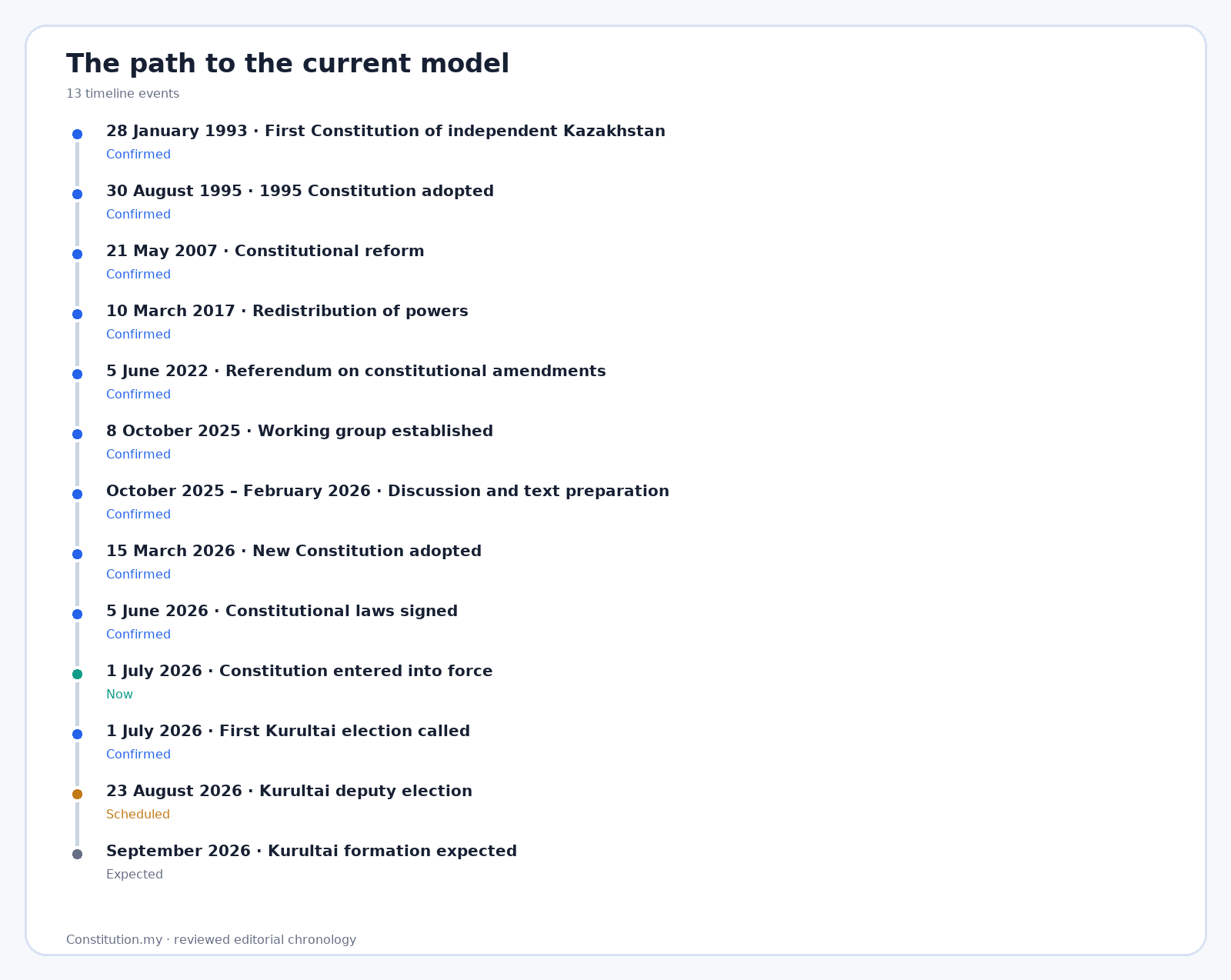
Kazakhstan's constitutional development – from the first Constitution of 1993 to the 2026 Constitution entering into force and the current reform stage.
Reform roadmap
What has already happened, what is happening now, and which reform stages are expected next.
Site Map
A complete list of the main pages, topic cards, and machine-readable resources on constitution.my.
Editorial and standards pages
About
About the constitution.my project, editorial policy, and official sources
Press Kit
Verified figures, key changes, publication-ready materials, and primary sources on Kazakhstan's 2026 Constitution for media.
Useful Formats
Charts, a journalist brief, and a research data pack built from the reviewed Constitution.my corpus.
What Changed
Public log of material constitution.my updates: sources, cards, AI formats, and current content status.
Implementation register
Checkable statuses of key constitutional changes, verification dates, and primary sources.
Task routes
Check change status
A precise route through rules in force, confirmed dates, and the next stages of the 2026 Constitution.
Find a rule and source
How to move quickly to a constitutional article, exact wording, primary source, and machine-readable data.
Prepare a brief
A route for an editorial, analytical, or internal brief: figures, edition comparison, and links.
Choose a rights remedy
A practical route: which right is affected, where to apply, and which materials to open first.
Participate and seek a response
A neutral route for an initiative, collective appeal, petition, or public oversight.
Equal access to rights
A neutral route on equality, access to education and health, and remedies without treating special legislation as the Constitution.
School and the Constitution
A short route through the right to education, school rules, and a next step in a dispute.
Turning 18: first steps
A route through participation, education, and first work or business experience without conflating the Constitution and special rules.
Business and a dispute with an authority
The constitutional basis for property and enterprise, plus a first route when a dispute with an authority arises.
Work and safety
First orientation on work, safety, and remedies without promising protections set by special labour law.
Family, services, and social protection
How to distinguish the constitutional foundation from a specific service, payment, or procedure.
Land, water, and environment
A neutral route on environmental information, participation, and remedies without replacing sector-specific regulation.
Equality, language, and freedom of conscience
A calm route on equality, language, belief, and the boundary of special rules.
Check a fact and a rule
An editorial route: fact, rule, primary source, and verification date without replacing legal review.
Editorial service pages
Editorial Policy
How constitution.my prepares, reviews, and updates its constitutional explainers.
Methodology
The official-source and editorial-methodology framework behind constitution.my materials.
Corrections and Updates
How constitution.my records clarifications, updates, and notable corrections in public materials.
Machine-readable resources Technical formats and public exports 77
These resources help search engines, AI clients, and external indexers consume the site structure and public corpus without guesswork.
Useful formats
Charts, journalist brief, and research data pack.
Journalist brief Markdown
Text brief with facts, dates, and source links.
Journalist brief PDF
One-page PDF for editorial work.
Service brief Markdown
Problem, constitutional frame, reviewed status, and sources without inferring a responsible body.
Source-based editorial pack
Neutral theses, transition context, dates, and links for explanatory material.
Assembled brief Markdown
A document from selected cards without registration or profiling.
Research data pack
CSV, JSON, JSONL, sources, field descriptions, and checksums.
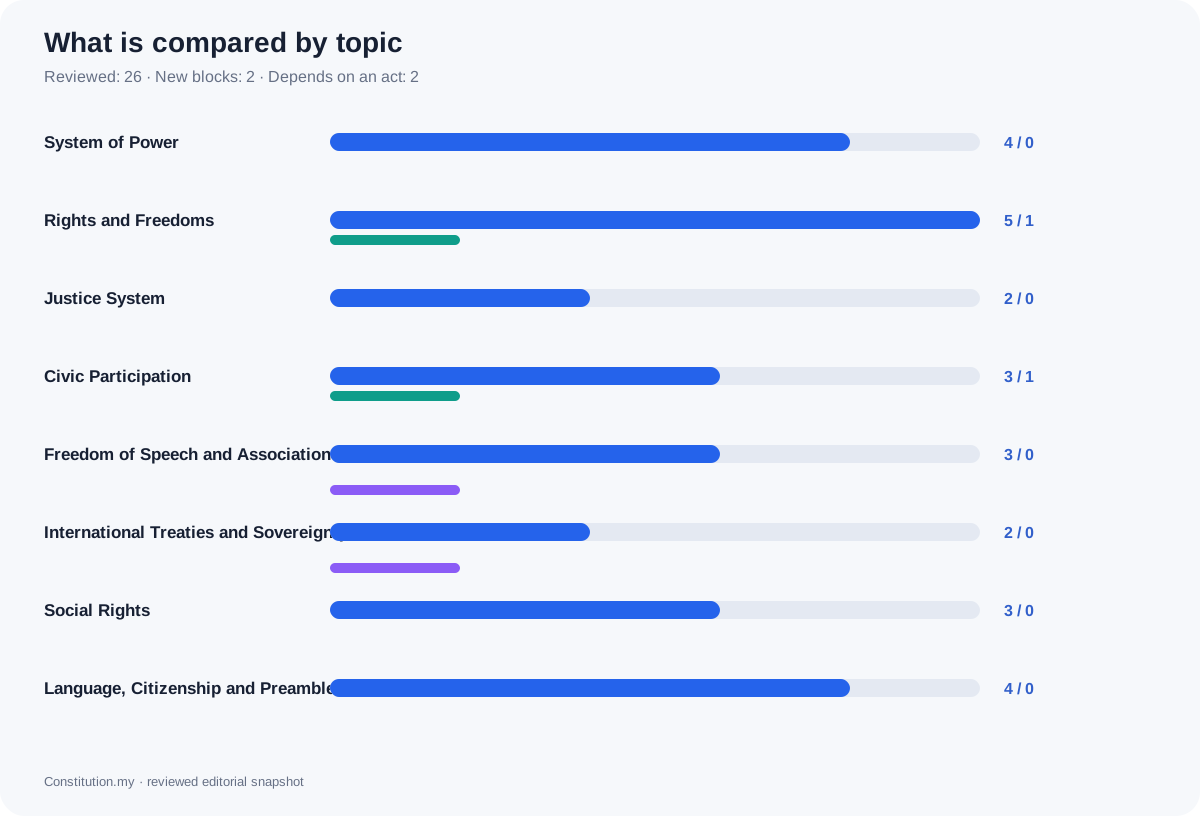
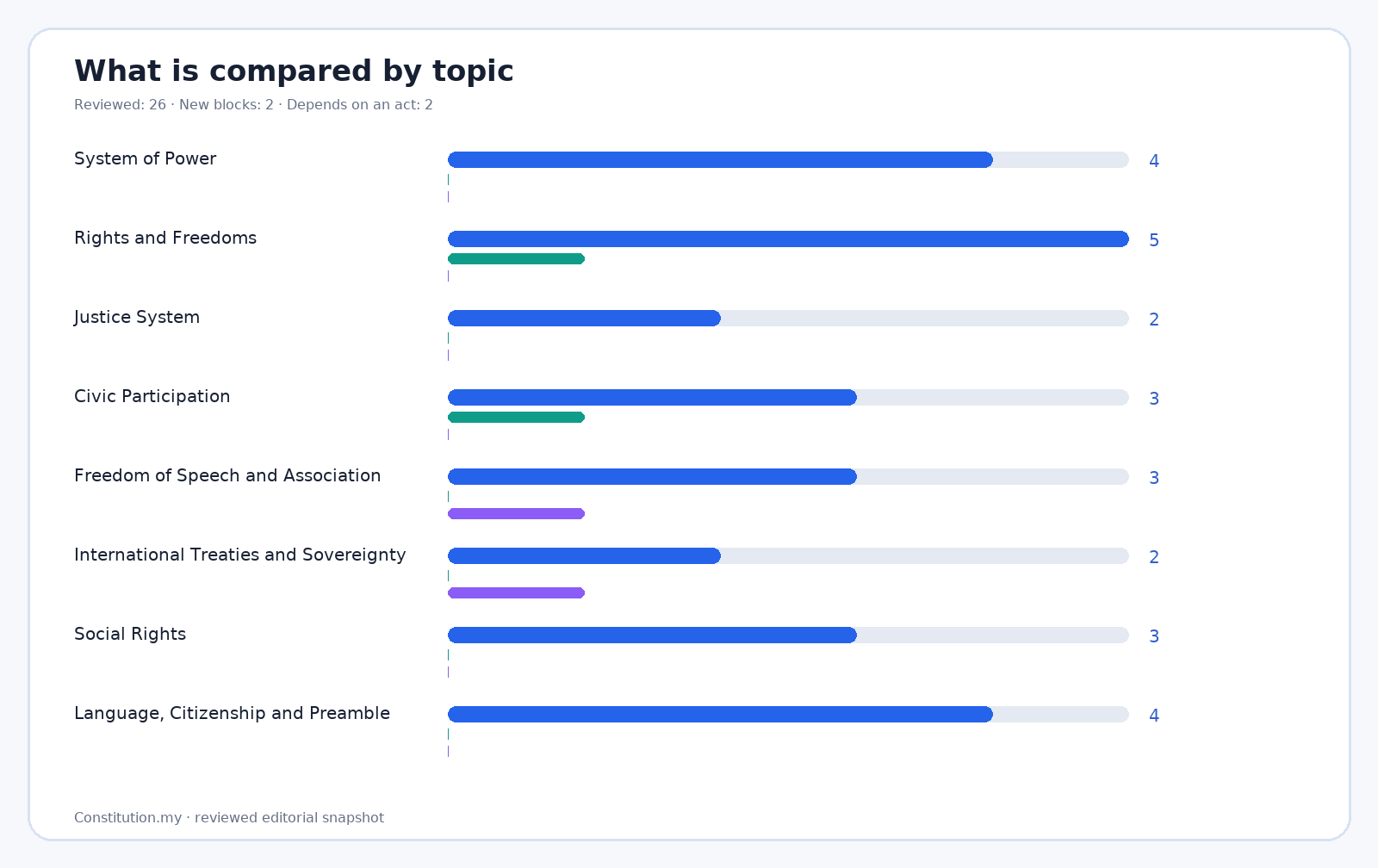
Changes chart SVG
Vector chart of thematic comparisons.
Changes chart PNG
Raster thematic comparison chart for publications.
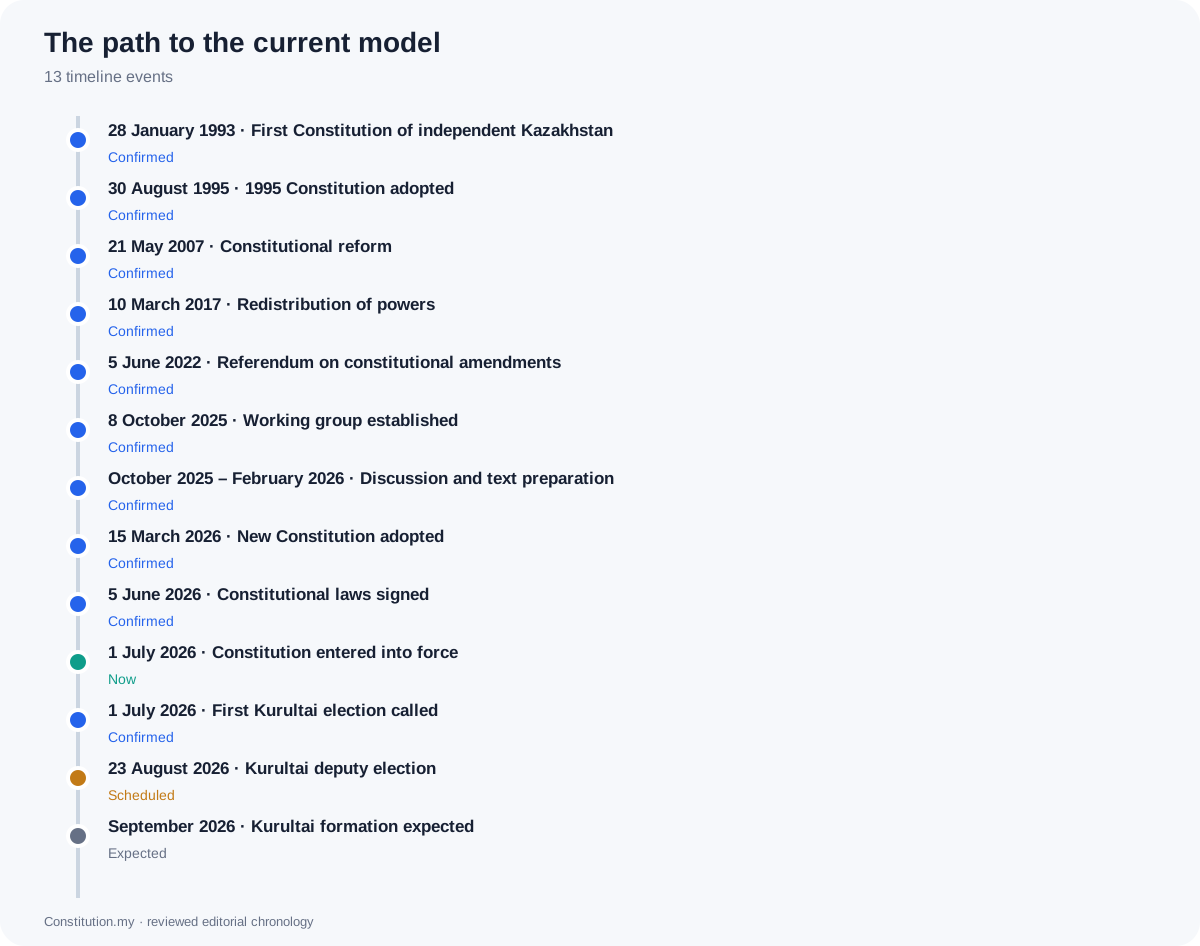
Transition chart SVG
Vector chronology with editorial statuses.
Transition chart PNG
Raster chronology for publications.
Edition comparison CSV
Tabular export of 26 comparisons with flags and provision links.
Edition comparison PDF
Ready one-page visual brief of thematic comparison blocks.
XML sitemap
Search-engine sitemap for indexing.
API: Featured content
Featured-cards API endpoint (supports lang parameter).
API: Full catalog
Full catalog API endpoint with filters and localization.
API: Basics
API for the essentials cards used on the Basics page.
API: Glossary
API payload for glossary terms and definitions.
API: Random term
Fetches a random term entry from glossary data.
API: Card by slug
Card payload by slug (sample slug for discoverability).
API: Search cards
Card search endpoint with example q parameter.
API v1: Documents
Canonical documents in the versioned corpus envelope.
API v1: Unified search
Search with canonical IDs and an explicit corpus version.
API v1: Verifiable claims
Published claims, statuses, and evidence links.
API: Search suggestions
OpenSearch-compatible suggestions across cards and glossary terms.
OpenAPI schema
Technical schema of public API routes for integrations and checks.
Health check
Public availability check without exposing internal secrets.
QazStack contract
Public projection of the canonical QazStack integration contract.
Feed (JSON) + Atom
General JSON/Atom feed for cards and updates.
RSS
Classic RSS feed for aggregators and feed readers.
RSS XML
RSS in XML format with canonical links and dates.
Feed XML
Alternative XML feed variant for content syndication.
Feed JSON
JSON feed variant for machine consumers and integrations.
Turbo feed
Specialized feed for Yandex Turbo and mirror integrations.
Dzen RSS
RSS feed for Yandex Dzen integration.
Zen RSS
Additional RSS endpoint for mirrors and archives.
Flipboard RSS
Card syndication feed for Flipboard pipeline.
Telegram Instant View
Instant View template for fast Telegram rendering of cards and full-text pages.
AI surface map JSON
Compact JSON map of the public AI-friendly site surfaces.
AI surface map XML
Compact XML map of the public AI-friendly site surfaces.
AI corpus JSONL
Line-delimited card corpus for direct retrieval and analytics ingestion.
Verified corpus JSONL
Line-delimited corpus containing only cards with checked sources.
Sources JSONL
Line-delimited list of checked sources and linked explainers.
Source freshness JSON
Compact report on source check dates, stale-risk signals, and source-to-card links.
Task routes JSONL
Line-delimited practical task routes and life situations.
Legal provisions JSONL
Line-delimited constitutional provisions with related explainers, sources, and comparison links.
Entity graph JSON
Compact graph of relationships across cards, articles, sections, and institutions.
Edition comparison JSON
Twenty-six reviewed differences with links to provisions in the 1995 and 2026 editions.
Timeline JSON
Reviewed reform chronology with statuses, dates, and primary-source references.
Updates log JSON
Machine-readable public log of material site updates.
Source registry JSON
Checked public sources for priority explainers.
Implementation register JSON
Key change statuses with verification dates and supporting sources.
Content inventory JSON
Compact inventory of content coverage, gaps, and recommended fill batches.
Article dossiers JSON
Constitution articles with related explainers, sources, and edition-comparison links.
Quality status JSON
Comparable freshness, language parity, and editorial coverage observations.
Export provenance JSON
Checksums, schemas, snapshots, and evidence references for machine exports.
Version manifest JSON
Full-text versions, content hashes, and available machine representations.
Akoma Ntoso XML
Publisher-local structured XML for the Constitution in force.
Full text JSONL
Preamble and 96 articles as line-delimited retrieval records.
Card Markdown
Clean Markdown card representation for AI clients and editorial systems.
Evidence passport JSON
Material, sources, provisions, checked claims, and links to evidence formats.
Evidence passport CSV
Tabular export of sources and coverage for one material.
Citation JSON
CSL-compatible citation metadata for an individual card.
Citation TXT
Plain-text citation for quick reuse.
Web Annotations
Machine-readable JSON-LD annotations for sources, quotes, and context.
Printable card
Printable HTML representation of a card.
OG/share image
Generated PNG image for card previews and sharing.
robots.txt
Crawl rules and discovery resource pointers.
humans.txt
Short human-readable note about the resource, owner, and status.
security.txt
Public contact file for security reports.
llms.txt
Compact AI-discovery index for public materials.
llms-full.txt
Full machine-readable corpus of compact explainers.
Pack: Rights
Subset focused on rights, remedies, and protections.
Pack: Kurultai
Subset focused on the Kurultai and the new institutional model.
Pack: Transition
Subset focused on timelines, rules now in force, and upcoming institutional steps.
Pack: Verified
Only cards with checked sources and primary-document links.
Pack: Referendum
Historical subset about the completed referendum phase.
Topic cards
Below are the real cards from the current content catalog, grouped by thematic site section.
About the Constitution
7
Full Text of the New Constitution
Here you can access the full text of the new Constitution of the Republic of Kazakhstan online in Kazakh and Russian, along with official publications and comparative materials.
How the New Constitution Was Developed
The new Constitution was created openly, with the participation of experts, citizens, and representatives of all regions. The process took six months – from September 2025 to February 2026 – and included collecting proposals, expert review, public discussions, and coordination.
How to Read the Constitution
It's better to read the Constitution in blocks rather than sequentially: first rights and freedoms, then the power structure and amendment procedure.
Key Changes in the New Constitution
The new Constitution preserves the foundations of statehood but changes the architecture of power and strengthens citizens' rights. Key changes: transition to a unicameral parliament, introduction of the Vice President, expansion of digital rights, and strengthened mechanisms of popular oversight.
What Is the Constitution
The Constitution is the fundamental law of the state that defines the structure of power, citizens' rights, and the basic rules of society. It is not a political program or ideological manifesto but the legal foundation upon which all other laws are built. The Constitution establishes the "rules of the game" for everyone – from the president to ordinary citizens.
What Types of Laws Exist and How They Relate to Each Other
The hierarchy runs: Constitution → constitutional laws → laws → presidential decrees → government resolutions → ministerial orders. Any lower-ranking act that contradicts a higher-ranking one has no legal force. The Constitution sits at the top.
Why We Are Updating the Constitution
The 1995 Constitution laid the foundations of an independent state. But over 30 years, the economy, technology, public expectations, and governance institutions have changed. Updating the Constitution is not abandoning previous values but aligning the legal system with the reality of 2026.
Rights
10
Basic Rights and Freedoms in the Constitution
The Constitution guarantees core personal, political, social, and digital rights. Below is what the 2026 Constitution now protects directly, which guarantees became stronger, and where to go if a right is violated.
Can Rights and Freedoms Be Limited
Rights may be limited only by law and only to the extent necessary for the aims in Article 41. Political restrictions are prohibited, and the rights in Articles 12, 14, 16, 17, 20, 22, and 25 may not be limited in any circumstances.
How Rights Are Limited During Emergency and Wartime
A state of emergency or martial law may involve temporary limits, but their legal basis, scope and duration must follow the Constitution and special law. Each measure should be assessed against the specific regime and act.
How to Protect Your Constitutional Rights
If a right is violated, the right path depends on the situation: an ordinary court, the Constitutional Court, the ombudsperson, or the prosecutor's office. Below is how to choose the right channel, what to prepare, and where to start without confusion.
I Was Detained by Police – What Are My Rights
If detained, establish the reason and actual time, request a lawyer and do not sign documents whose content has not been explained. Article 18 leaves detention periods to law; seek legal assistance for a concrete case.
My Personal Data Was Leaked – What Should I Do
The Constitution protects personal data against unlawful collection, processing, storage, and use, including with digital technologies. If your data are leaked, preserve evidence, contact the data operator, and submit a complaint to the Information Security Committee.
What Digital Rights Mean in the New Constitution
The 2026 Constitution expressly protects personal data and the secrecy of communications transmitted using digital technologies. The legal grounds for processing data, accessing communications, and restricting information remain defined by law; biometric data are regulated under personal-data legislation rather than named separately in the Constitution.
What Does the 'Direct Effect' of the Constitution Mean
Direct effect allows a person to invoke a constitutional provision, but it does not dispense with evidence, time limits, procedure or requirements of special legislation. In a concrete dispute, read the constitutional text with the applicable procedure.
What Duties Citizens Have Under the Constitution
The Constitution establishes both rights and citizens’ duties. Duties are not the price of having rights: their scope, performance and consequences are determined by the Constitution and special laws.
What Rights a Person Has Upon Detention
If detained, establish the reason and actual time, request a lawyer and retain the documents. Article 18 leaves detention periods to law; the applicable procedure depends on the type of proceeding and the person’s status.
Government
8
Constitutional Court
The Constitutional Court is an independent body of constitutional review. A citizen may challenge a normative legal act that directly affects their constitutional rights, but the constitutional law sets admissibility conditions for that route.
Government of the Republic of Kazakhstan
The Government is the highest executive body responsible for implementing state policy, managing the economy, social development, and public administration. It is formed by the President and is accountable to both the President and the Kurultai under the new constitutional model.
Kurultai: Kazakhstan's New Parliament
The Kurultai is the unicameral parliament of the Republic of Kazakhstan. The 2026 Constitution replaces the bicameral structure of the Senate and Mazhilis with a single representative body of 145 deputies elected through a nationwide proportional system. Its constitutional powers are significantly greater than those of the previous parliament.
Local Government and Self-Government
Local government and self-government are the institutions through which public authority is exercised at the level closest to citizens. They include local executive bodies, representative bodies, and self-government mechanisms that address everyday issues such as infrastructure, services, local budgets, and community development.
National Bank
The National Bank is the central bank of the Republic of Kazakhstan. Its primary objective is price stability; it also works on monetary policy, payment systems, currency regulation and financial stability. The Chair of the National Bank is appointed by the President.
President of the Republic of Kazakhstan
The President is the head of state, guarantor of the Constitution, and protector of the rights and freedoms of citizens. The 2026 Constitution preserves the presidential form of government and strengthens checks and balances through Kurultai consent for several defined appointments.
Prosecutor General
The prosecution service exercises the highest supervision over legality on behalf of the state within the limits and forms established by law. The President appoints and dismisses the Prosecutor General, who serves one non-renewable six-year term.
Vice President of the Republic of Kazakhstan
The Vice President is a new constitutional office created to ensure continuity of governance, coordination, and institutional stability. Appointed by the President with the consent of the Kurultai, the Vice President acts on the President's instructions and does not constitute an independently elected political centre.
Local Government
6
How a Citizen Can Participate in Governing the Country
Participation extends beyond elections: citizens may submit appeals, join peaceful assemblies and public councils, apply to the Constitutional Court, and support petitions under the Administrative Procedural Code. You can stand for election to a maslikhat from age 20 and to the Kurultai from age 25.
What Local Self-Government Is and How It Differs from Local Administration
Local administration is a top-down hierarchy: akims appointed from the centre. Local self-government is a bottom-up initiative: residents themselves decide what to repair and build. Since 2021, village akims are elected by residents. The 2026 Constitution enshrines self-government at the constitutional level.
What the Akim Does
The akim is the head of the local executive authority and is responsible for administration, implementation of state policy, and management of local affairs within the relevant territory. In everyday life, the akim’s role is highly visible because it directly affects services, infrastructure, and local development.
What the Local People’s Council Is
The local People’s Council is a proposed participation mechanism at the local level through which residents, community representatives, experts, and civil society actors can discuss local issues and communicate them to public authorities. It is intended as a channel of dialogue, not a replacement for elected local institutions.
What the Maslikhat Does
The maslikhat is the local representative body through which local interests, oversight, and political accountability are expressed. Local governance should not consist only of executive administration – it must also include representation and public scrutiny.
Why Local Self-Government Matters
Local self-government matters because it is the level of public power closest to people’s everyday lives. It determines how communities are heard, how local priorities are set, and how quickly public problems can be identified and addressed.
Civic Participation
4
How Citizen Appeals and Petitions Differ
Article 35 of the Constitution preserves the right to submit individual and collective appeals. Petitions are governed by Chapter 12-1 of the Administrative Procedural Code: they are a separate process for addressing public and local authorities, not a direct citizen right to introduce bills in the Kurultai.
What Public Oversight Means
Public oversight means that citizens, experts, media, and civil society organizations can monitor public decisions and the way they are implemented. In the new constitutional model, it forms part of democratic participation beyond elections.
What Role Civil Society Plays
Civil society is the sphere of organizations, communities, experts, initiatives, and associations that exist outside the state but actively influence public life. Under the new constitutional model, civil society gains a stronger role as a channel through which citizens can shape discussion, oversight, and reform.
What the Kazakhstan People’s Council Is
The Kazakhstan People’s Council is the highest constitutional consultative body representing the interests of the people. It has 126 members, with 42 drawn from each of three groups – ethnocultural associations, public and other non-profit organisations, and maslikhats and public councils. It may issue recommendations, introduce bills in the Kurultai, and initiate a nationwide vote.
Practical
12
How the Constitution Protects the Right to Education and Health
The Constitution establishes core guarantees for education and health. Admission to school, the scope of free care, service quality and the route for challenge depend on special law and the concrete circumstances.
How the Relationship Between International Treaties and National Laws Will Change
The relationship between an international treaty and national law depends on the Constitution, the treaty’s legal status and the applicable legislation. For a concrete dispute, read the official text, ratification act and relevant procedure together.
How to Check Information About the Constitution
The safest way to verify claims about the Constitution is to compare them with the full text, official comparison tables, and official explanatory materials. Social-media posts and short quotations often leave out context and can create a distorted impression.
How to Discuss the Constitution With Family, Friends, or Colleagues
Discuss the Constitution by focusing on the actual text, before-and-after comparisons, and practical examples rather than slogans or out-of-context excerpts. The goal should be understanding, not winning an argument.
I Want to Start a Business – What Does the Constitution Guarantee
The Constitution establishes freedom of enterprise, property rights and judicial protection. Starting a business and resolving a dispute also require compliance with sector-specific law, documentation and time limits.
I Was Fired – What Are My Constitutional Rights
The Constitution guarantees the right to work and protection against unemployment. If dismissed unlawfully, you can turn to the court, the labour inspectorate, or the ombudsman. The new Constitution strengthens social guarantees and prohibits discrimination.
My Child Was Refused Entry to School – What Does the Constitution Say
The Constitution guarantees compulsory free secondary education. If a child is not admitted, keep the notice and verify the stated reason with the school and education authority; the next step depends on the circumstances.
What the Constitution Says About Property and Business
The Constitution establishes property rights and freedom of enterprise. For a dispute about property, land, a contract or market access, special laws, procedure and the documents of the concrete case also matter.
What the New Constitution Changes for an Ordinary Person
Constitutional change does not usually transform daily life overnight, but it can significantly affect how rights are protected, how public authority is exercised, how local participation works, and how the state interacts with citizens over time.
When the New Constitution Entered Into Force
Following the referendum of 15 March 2026, the new Constitution entered into force on 1 July 2026. Until then, the 1995 Constitution remained in force. During the transition period (16 March – 30 June), all institutions continued operating, key laws were signed on June 5, and preparations continued for Kurultai elections.
Where to Ask Questions
If you have questions about the new Constitution, referendum procedure, or your rights, use official information portals, election resources, legal-information platforms, and authorised public institutions rather than relying on unverified online commentary.
Why Reading the Text Matters
In a referendum, a citizen votes not on a slogan, but on a legal text that shapes the foundations of the state. That is why reading the Constitution itself remains essential for understanding what changes and how new rules affect your rights.
History
5
How Kazakhstan Reached the 2026 Constitution
The 2026 Constitution did not emerge suddenly. It is the product of a long constitutional evolution that began with independence in 1991, passed through the Constitutions of 1993 and 1995, and accelerated significantly after the constitutional changes of 2022.
How to Read Constitutional Changes Correctly
Constitutional change is easiest to understand when read historically rather than as isolated legal fragments. The best approach is to compare the previous and proposed texts and place them in the sequence of 1993, 1995, 2022, and 2026.
What the 1993 Constitution Was
The 1993 Constitution was the first Constitution of independent Kazakhstan. It established the legal foundations of sovereignty and marked the transition from the Soviet legal order to a national constitutional system. It remained, however, a transitional document and was soon superseded by a more stable constitutional model.
What the 1995 Constitution Changed
The 1995 Constitution created the basic framework of Kazakhstan’s modern state system. It clarified the structure of power, consolidated the presidential model, and provided the legal foundation for institutional stability over three decades.
What the 2022 Constitutional Reforms Changed
The 2022 constitutional reforms were aimed at rebalancing Kazakhstan’s political system. They marked a shift away from an overly centralised model toward a more balanced institutional arrangement, and served as a direct precursor to the deeper reforms of 2026.
Myths
12
Myth: 'A Referendum Is Always Better Than Parliament Because the People Decide'
A referendum does not replace parliament – it complements it for fundamental questions. Voting on a budget or a tax code with a simple Yes/No is not feasible. The 2026 referendum is the appropriate case: 84% of the text is new, and the structure of power is fundamentally different.
Myth: 'If the Constitution Was Adopted by Referendum, It Must Be Perfect'
A referendum confers legitimacy – but not perfection. The US Constitution began by enshrining slavery. Kazakhstan's 1995 Constitution required 56 amendments in 2022. Every constitution is a compromise. That is precisely why the 2026 Constitution builds in mechanisms for renewal: the Constitutional Court, amendments, and the Khalyk Kenesi.
Myth: 'If the Law Says So, the Constitution Doesn't Matter'
Myth: 'The law is the law – the Constitution has nothing to do with it.' Fact: the Constitution stands above any law. If a law contradicts the Constitution, it has no legal force. The Constitutional Court strikes down unconstitutional provisions on any citizen's application – free of charge via eGov.
Myth: 'The Constitution Doesn't Work Anyway, So What's Written in It Doesn't Matter'
The claim that 'the Constitution doesn't work' is a common myth. Since 2023, the Constitutional Court has accepted dozens of applications from ordinary citizens and struck down several unconstitutional provisions. Applications are free and submitted via eGov. The Constitution works – when people use it.
Myth: 'The Constitution Is All About Rights and Nobody Mentions Duties'
Myth: 'The Constitution is just about demanding rights; duties are forgotten.' Fact: the section is titled 'Rights, Freedoms and Duties.' Duties are written out explicitly: taxes, defence, care for children and parents, protection of the environment. Rights and duties are inseparable.
Myth: “Any Constitution is good simply because it is a Constitution”
Not every constitution is good merely by virtue of existing. A constitution can be democratic and rights-protecting, or it can be vague, overly centralized, weak in guarantees, and ineffective in practice. What matters is not the title of the document, but its content, safeguards, and real operation.
Myth: “Boycott is the strongest political response”
A boycott is not the same as a “No” vote. The official record counts turnout and votes cast, not a separate boycott category. Final turnout on March 15, 2026 was 73.12%, and 87.15% of participants voted in favor. A “No” vote affected the result; non-participation was not counted as a protest vote.
Myth: “Everything changes the next day after the referendum”
No. Citizens voted on March 15, the key laws were signed on June 5, and the Constitution entered into force on 1 July 2026. The legal system does not transform overnight: elections, decrees, and institutional launch follow in sequence.
Myth: “If a referendum has only one question, there is no real choice”
A single-question referendum is not automatically fake, invalid, or meaningless. If the issue submitted is a unified constitutional project, one question can reflect a yes-or-no decision on the project as a whole. The key issue is not the number of questions but whether citizens have enough information to make an informed choice.
Myth: “The new Constitution will improve life immediately”
A Constitution is a legal foundation, not an automatic outcome. Real change depends on laws, court practice, and civic use. The distance between a norm and daily reality is usually measured in years of institutional work.
“The Kurultai is just the Mazhilis under a new name”
It is not a simple rename: the Senate is abolished, presidential appointments are removed, the election system changes, the threshold rises from 5% to 7%, and women, young people, and persons with disabilities must jointly make up at least 30% of a party list.
“The People's Council replaces Parliament”
No. The People's Council is a consultative body without the power to pass laws. Only the Kurultai adopts laws. The Council may submit initiatives, but they are not automatically binding.
Current Focus
12
How are office terms counted after the new Constitution entered into force?
On July 7, 2026, the Constitutional Court explained that holding the relevant office under the 1995 Constitution does not itself prevent a new election or appointment. For limits in the new Constitution, an election or appointment after July 1, 2026 is treated as the first.
How will digital rights work in practice?
The new Constitution for the first time enshrines personal data protection and the right to submit electronic appeals to state bodies. Implementation will require subordinate legislation – expected in 2026–2027.
How will the Kurultai be formed?
The Kurultai is a unicameral supreme representative body of 145 deputies. The constitutional law on the Kurultai was signed on June 5, 2026, and on July 1 the President signed the decree calling the first elections. The first Kurultai deputy elections were held on August 23, 2026.
What Changed on July 1, 2026
Since July 1, 2026, the Constitution has been in force. The digital-rights provisions and detention safeguards under Article 18 now apply; detention periods are set by law. The right to submit appeals continues, while petitions follow a separate process under the Administrative Procedural Code.
What Happens During the Transition Period
The transition period from March 16 to June 30, 2026 is complete. Key laws were signed on June 5, the new Constitution entered into force on July 1, and the decree calling Kurultai elections has been signed.
What We Already Know About the 2026 Kurultai Elections
The Kurultai election was held on 23 August 2026. The CEC published the results on 25 August; the first session opened on 28 August. The Kurultai is a unicameral parliament of 145 deputies.
What changed after the Constitution entered into force?
On 15 March 2026, citizens of Kazakhstan approved the new Constitution in a referendum. Key constitutional laws were signed on June 5, the Constitution took effect on July 1, and on the same day the decree calling Kurultai elections was signed. Kurultai deputy elections were held on August 23, 2026.
What constitutional laws were signed on June 5, 2026?
Four core laws cover the President, the Kurultai, the Constitutional Court, and the Kazakhstan People's Council. They entered into force on July 1, 2026. The Kurultai law sets 145 seats, a 7% threshold, and an aggregate quota of at least 30% for women, young people, and persons with disabilities; citizen access to the Constitutional Court has operated since 2023.
When Will Kurultai Elections Be Held
The Kurultai election was held on 23 August 2026. The CEC published the results on 25 August; the first session opened on 28 August. The Kurultai is a unicameral parliament of 145 deputies.
When did the new constitutional laws take effect?
Some of the key laws were already signed on June 5, 2026. The Constitution itself took effect on July 1, and the next steps now depend on the signed decree for Kurultai elections and on the institutions tied to the new parliament.
When will the Vice President appear and what is the role?
Erlan Karin was appointed Vice President on 31 August 2026 by Decree No. 1417. Under the Constitution, the Vice President is appointed by the President with the consent of the Kurultai.
Which New Institutions Come Next
Erlan Karin was appointed Vice President on 31 August 2026 by Decree No. 1417. The law on the People’s Council is in force; its Secretariat was created on 2 July. Citizens have been able to apply to the Constitutional Court since 2023.
Kurultai Elections
3
How is the Kurultai different from the Mazhilis and the Senate?
The Kurultai is a unicameral parliament. The Senate and presidential appointments to parliament are abolished. There are 145 deputies instead of 147 and the threshold rises from 5% to 7%. Women, young people, and persons with disabilities must jointly make up at least 30% of a party list.
How is the People's Council formed?
The body has 126 members divided into three equal groups: ethnocultural associations (42), NGOs and civil society (42), and maslikhats plus regions (42). Candidates are nominated by those structures and then approved by the President.
When will the Vice President appear and how is the office filled?
Erlan Karin was appointed Vice President on 31 August 2026 by Decree No. 1417. Under the Constitution, the Vice President is appointed by the President with the consent of the Kurultai.
Constitutional Laws
3
Law on the Constitutional Court – what changes?
The Constitutional Court retains its role as guarantor of constitutional supremacy. The new model changes the composition from 11 to 10 judges, the appointment process, and term length; citizen applications have been accepted since January 1, 2023.
Law on the Kurultai – building a new parliament from scratch
The law on the Kurultai was signed on June 5, 2026. It fixes a unicameral parliament of 145 deputies elected by proportional representation, and on July 1 the President signed the decree calling the first elections. Kurultai deputy elections were held on August 23, 2026.
Law on the President – what changes?
The constitutional law on the President was signed on June 5, 2026. It already aligns presidential powers with the new Constitution by introducing the office of Vice President and the new order of succession.
Referendum
8
How the Referendum Turnout Threshold Works
A referendum requires participation above 50%, and the “Yes” option must prevail in at least two thirds of the regions. Final turnout on March 15, 2026 was 73.12%, so the participation threshold was met. A repeat referendum cannot be held for at least one year.
What Campaigning Rules Apply Before the Referendum
Campaigning is permitted from 12 February to 13 March – both 'For' and 'Against' on equal terms. 14 March is a day of silence: no campaigning. 15 March is polling day. Prohibited: vote-buying, coercion, abuse of official position. These rules apply online as well.
What Is Happening and What Comes Next
Voting took place on 15 March 2026. 87.15% voted in favour at 73.12% turnout. The Constitution was adopted and entered into force on 1 July 2026. The CEC published the Kurultai election results on 25 August 2026. The first session of the first Kurultai opened on 28 August 2026.
What Is a Referendum
A referendum is a nationwide vote with direct legal force. Every citizen aged 18 and over votes personally and in secret. Three conditions must be met: turnout above 50%, a majority of 'Yes' votes, and 'Yes' in at least 2/3 of regions. The result is binding – it can only be reversed by another referendum.
What Question Is on the Ballot
The ballot contains one question: 'Do you accept the new Constitution of the Republic of Kazakhstan, the 2026 Constitution of which was published in the mass media on 12 February 2026?' The answer is 'Yes' or 'No.' Voting is secret.
What Questions Can Be Put to a Referendum
A referendum is intended for issues of fundamental public and constitutional importance, not for routine administrative decisions. It is the mechanism by which citizens directly decide questions affecting the foundations of the state, the constitutional order, or other matters of nationwide significance.
Who Monitors the Integrity of the Vote
At every polling station – observers from parties, NGOs, media, and international missions (OSCE/ODIHR, SCO, CIS). Observers from more than 30 countries have been invited. Each observer receives a copy of the count protocol. Discrepancies are grounds for verification and a court challenge.
Why It Matters to Adopt the Constitution by Referendum
Adopting the Constitution by referendum gives it especially strong political and public legitimacy. On March 15, 2026, citizens of Kazakhstan approved the updated basic law directly, rather than leaving the decision only to state institutions.